


My childhood was characterized by generations of farmers, lumberjacks, coal miners and loggers. My parents had seven years of primary school as their highest level of education. Their working life started on the assembly line of the Swedish Telecommunications Authority. As a child, I was told to always do my duty, to contribute what I can to both family and society. At the age of ten, I started earning my own money by selling ice cream and used comic books to neighborhood kids. I started handing out flyers in the sixth grade, riding the bus into town twice a week with a giant mullet of flyers. By taking on larger deliveries and using my mom’s daycare to sort and package, I could hand out four or five flyers in a round and make as much as 15 cents per household.
I didn’t know it at the time, but I was already an entrepreneur at a young age. Entrepreneurship is often described as starting and running your own business, but it is now seen as an important approach in the private sector, the public sector and civil society. The EU highlights initiative and entrepreneurship as key competences for growth and prosperity. The modern definition of entrepreneurship is to take the initiative for value-creating actions in everyday life and to constantly learn new things.
When I was a kid, my father struggled with his engineering course from Hermods in the evenings, and my mother sighed over difficult math problems to finish primary school. The constant learning was natural and not something I reflected on. My father continued with management courses, became a business manager and then developed his own education, while my mother studied to become a nanny for work at a preschool. I was born with a thirst for knowledge, but my social heritage had a big influence. I took extra courses in primary school and I studied outside the curriculum in secondary school. As an adult, I have taken countless courses and completed my university degree outside of work, always eager to contribute value and, above all, to constantly learn new things.
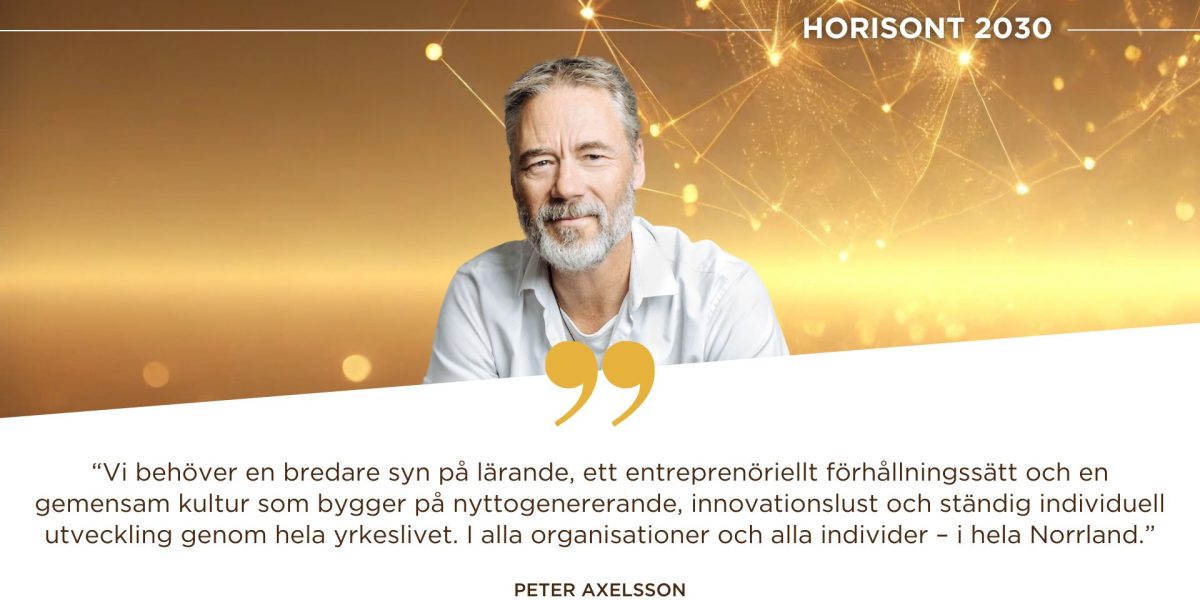
Society has changed a lot since the 1970s. When I started first grade, half of all Swedes had compulsory school as their highest level of education and only 10% had studied post-secondary education. Today, every second Swede has a post-secondary education and the proportion with only compulsory school is 10% and is steadily decreasing, even in northern Sweden. But for Norrland to strengthen its position, more is needed than basic education and replenishment of new students. We need a broader view of learning, an entrepreneurial approach and a common culture based on benefit generation, innovation and continuous individual development throughout professional life. In all organizations and all individuals throughout Norrland.
The road ahead is lined with obstacles. Lack of time and workload is one. High production pressure means that staff rarely have time to reflect or participate in further training. Paradoxically, lack of skills is perceived as one reason for this pressure. Economic factors are another. Skills development is often perceived as costly and employers prefer to prioritize efficient staffing over allocating time and resources for learning. Lack of systematization is a third. Supportive structures for continuous learning are lacking, with people in smaller organizations and outside central cities finding it particularly challenging. These barriers put learning on the margins.
Fredrik Bünsow donated SEK 5000 to Sundsvall’s new library in 1897 with the condition that the proceeds would be used to purchase educational books. His contribution made a long-awaited public library possible. In 2030, we follow Fredrik Bünsow’s example and allocate a much larger share of time and resources to education, development and learning. Regional leadership
is leading the way and demonstrating that lifelong learning is important for all of us, for employers and employees alike. We are blending approaches and collaborating on initiatives across the region and, above all, we are driven by a strong interest in learning that is evident in every context and in every encounter.
Long-term success is about learning faster than your surroundings. The mantra is: What can I learn from this? Norrland 2030 competes successfully and is the region of entrepreneurs – the region of value creation, innovation and learning!
Peter Axelsson, Masarin Consulting Group